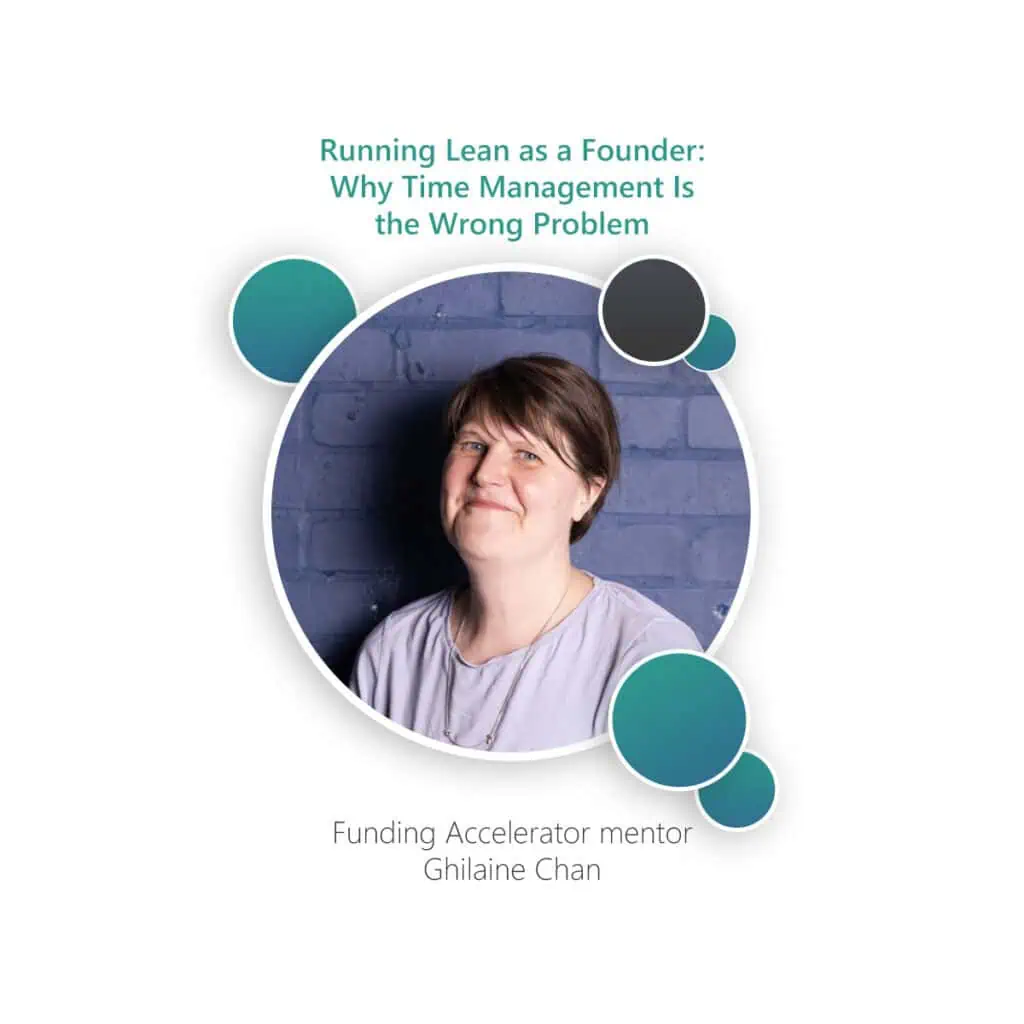
Running Lean as a Founder: Why Time Management Is the Wrong Problem

Running Lean as a Founder: Why Time Management Is the Wrong Problem banner.

Most founders don’t feel short on ideas.
They feel short on energy.

They’re busy all the time, but the business still feels fragile.
Customer delivery is working.
Revenue is moving.
But there’s no headspace to think, improve, or step back.

That’s not a time problem.
It’s an operating problem.

In a recent Focused for Business mastermind session, operations specialist and Focused For Business mentor Ghilaine Chan worked through what running lean actually looks like in practice. Not in theory. Not as a productivity framework. But in the messy reality founders often live in.

The big takeaway surprised a lot of people.

Running lean isn’t about doing more with less time.
It’s about doing the right things with the right energy.

Why founders feel overwhelmed even when they’re “productive”

Founders often assume overwhelm means they’re disorganised.
Or undisciplined.
Or not using the right tools.

That’s rarely true.

Most founders are juggling:

  • Strategic thinking
  • Customer delivery
  • Team management
  • Admin and finance
  • Sales and fundraising
  • Personal responsibilities

Often in the same day. Sometimes in the same hour.

The problem isn’t volume.
It’s constant context switching.

When you bounce between deep thinking, reactive work, and admin all day, your brain never settles. You’re working, but rarely in flow. That’s why days feel exhausting without feeling effective.

This is where the idea of energy management rather than time management becomes critical.

Energy management beats time management every time

Every task asks something different of you.

Writing strategy needs focus and creative energy.
Responding to emails needs attention but little imagination.
Admin tasks need patience, not thinking.

Treating all of these as equal “blocks of time” is what breaks founders.

Instead, Ghilaine encourages founders to start by asking two questions:

  • When during the day am I mentally fresh?
  • When do I naturally slow down?

Most people have a predictable rhythm.
Some are “larks”, sharp early.
Others are “owls”, clearer later in the day.

Ignoring that rhythm creates friction.
Working with it reduces stress immediately.

Protecting your best energy for the work that matters

Founders often use their sharpest hours on the wrong things.

Inbox clearing.
Slack replies.
Small admin tasks.

The result is that the most important work gets pushed into tired moments or endlessly delayed.

A simple shift helps:

Use your freshest time for blank-page work.
The thinking that actually moves the business.

That might be:

  • Solving a strategic problem
  • Preparing for investor conversations
  • Designing a new offer
  • Writing something that needs clarity

This isn’t about rigid schedules.
It’s about protecting one meaningful block each day.

Even 30 minutes done consistently compounds fast.

Why “discipline” fails and devotion works better

A lot of founders flinch at the word discipline.
It feels punishing.
Like another thing they’re failing at.

One idea from the session landed strongly:
replace discipline with devotion.

Devotion to:

  • Your energy
  • Your clarity
  • Your long-term ability to lead

Running lean requires maintenance.
Like a garden, not a machine.

Small daily care matters more than big resets.

No system works if it’s ignored for three weeks.
No tool saves you if you don’t engage with it.

This reframing removes guilt and creates consistency.

Delegation and automation are not shortcuts

When founders feel overwhelmed, they often reach for tools or delegation too early.

Automation promises relief.
Delegation sounds like freedom.

But both can backfire if done without clarity.

Before handing anything over, founders need to answer:

  • What does “good” look like here?
  • Why does this task exist?
  • Does this reflect our values to customers?

Poorly designed automation creates more work.
Bad delegation creates stress and rework.

A simple rule helps:

  • Automate boring, repetitive work after you understand it.
  • Delegate tasks you dislike once you know the outcome you expect.

Computers are great at dull tasks.
Humans are not.

But someone still needs to design the process first.

Running lean without burning out

A lean business is not a frantic business.

Founders often confuse speed with effectiveness.
But exhaustion leads to mistakes, not progress.

A few practical shifts make a big difference:

  • Build buffers between meetings
  • Avoid back-to-back calls where possible
  • Batch similar tasks together
  • Set expectations around response times

Boundaries aren’t selfish.
They’re operational.

If you respond instantly, people expect instant responses.
If you create space, others solve more problems themselves.

This is how teams become more resilient.
And how founders regain headspace.

The real definition of “lean”

Running lean doesn’t mean squeezing yourself harder.

It means:

  • Knowing what actually moves the business
  • Protecting energy for that work
  • Designing systems that support humans, not exhaust them
  • Letting go of guilt about unfinished to-do lists

Lean businesses are calm businesses.
They make clearer decisions.
They raise money more effectively.
They scale with fewer cracks.

Founders don’t need more hacks.
They need fewer arguments with themselves about what matters.

If you are preparing your business for investment, why not join a free, online Funding Strategy Workshop where you will hear three insights that increase your chances of successfully raising investment and can ask any questions you may have. Book your place.

FAQs – Running Lean as a Founder

What does running lean actually mean for a startup founder?

Running lean means focusing effort on what truly moves the business, rather than doing more work. It prioritises clarity, energy, and sustainable systems.

Why doesn’t time management work for founders?

Because founders juggle tasks that require very different types of mental energy. Treating them all as equal blocks of time leads to fatigue and poor decisions.

How do I decide what to automate or delegate first?

Start with tasks you dislike or that drain energy, but only once you understand what good outcomes look like. Avoid automating broken processes.

Can running lean help with fundraising?

Yes. Founders with clarity and headspace make better strategic decisions, prepare more effectively, and communicate with more confidence during a raise.

What’s one small change I can make immediately?

Protect one daily block for deep, important work and keep your inbox closed during that time. Even 30 minutes makes a difference.

Latest Blog & News

Customer profiling that drives customer acquisition with Sarah Jones banner.

Customer profiling that drives customer acquisition

“Who exactly is your target customer?” It’s a question investors ask founders again and again. Not in a vague demographic sense, but in a

Startup support: What founders say matters most

There is no shortage of startup advice. Books, podcasts, accelerators, incubators, workshops, communities and mentors all promise to help founders succeed. But if you
Focused For Business ranked #13 in Europe for mentoring quality by the Financial Times banner.

Focused For Business ranked #13 in Europe for mentoring quality by the Financial Times

Focused For Business has been ranked #13 in Europe for mentoring quality in the Financial Times’ Leading Startup Hubs 2026 report. The ranking is
Grant vs Equity Fundraising banner.

Grants vs Equity Funding: What Assessors and Investors Really Look For

For early-stage startups, it can be a toss-up whether to go for grant funding or to start reaching out to investors about equity funding.
Creating Calm banner.

Creating calm to bolster founder creativity: practical tools that work with Olivia Greenberg

There’s always more to do as a founder – whether it’s get more customers, launch new product, raise funds for growth – the list
AI investing, here to stay or about to go bust banner?

AI startup funding, here to stay or about to go bust?

If you’re a founder, it’s hard to ignore the noise. AI is everywhere. Every other pitch deck has “AI-powered” on slide one. VCs talk
Bridge Funding banner.

Bridge funding for startups: when, why, and how to run it well

Bridge funding is designed to buy time, not to fix fundamentals. Used well, it gives you enough runway to reach a clear value milestone
2025 roll-call, the founder funding articles you cannot afford to miss banner.

2025 roll-call, the founder funding articles you cannot afford to miss

This round-up collects the most useful guidance we published in 2025, grouped by four pillars. The aim is simple, to help you raise well
Breakthrough Founders banner.

New UK-wide initiative ‘Breakthrough Founders’ launched to support entrepreneurs from overlooked groups

A new, outcomes-focused initiative will support 150 startups led by entrepreneurs from traditionally overlooked groups across the UK to raise investment and scale. Launched
startup exit legal advice banner.

Preparing to Exit Your Startup: Essential Legal Advice for Startup Founders and Entrepreneurs

Exiting your business is a big moment. It usually marks the end of a long journey, building your startup from the early days to
Overcome The Impossible: How To Secure Investment For Your Startup banner.

Overcome The Impossible: How To Secure Investment For Your Startup

If you’re struggling to secure investment for your startup, you’re not alone. Many founders find the process overwhelming, especially when you are raising investment
FFB_Blog_Banner_Exit_Strategy

This Is Why A Business Exit Strategy Actually Attracts Investors

Have you ever wondered why investors are so focused on exits? You’re pitching your vision, your passion, your drive, and they’re asking, “How do
How To Build Investor Relationships Before You Need Equity Investment banner.

How To Build Investor Relationships Before You Need Equity Investment

Build Investor Relationships Before Your Startup Needs Funding When it comes to securing investment for your business, timing is everything. But here’s the kicker,
How To Make A Pitch Deck That Attracts Investors banner.

How To Make A Pitch Deck That Attracts Investors

Let’s talk about your pitch deck. Every founder knows they need one if they want to raise equity investment. Most founders have probably created
Financial Forecasting For Startups Part 1 banner

Part 1 – Financial Forecasting For Startups: How Much Money Do I Need?

Financial Forecasting Part 1: How Much Funding Does Your Startup Need? One of the first questions you need to answer if you are raising
How To Value A Small Business To Get Investors Excited banner

How To Value A Small Business To Get Investors Excited

Raising investment can be challenging. The preparation, pitching, and negotiation is a time-consuming process, and can distract founders from their primary goal: Growing their
Resilience training: 6 Proven Hacks to Boost Resilience When Fundraising banner.

Resilience training: 6 Proven Hacks to Boost Resilience When Fundraising

Jennifer Clamp, founder of Aata, and one of our trusted mentors on our Funding Accelerator programme, recently led a resilience training workshop on how
Dorset LEP & Focused For Business Team Up banner

Exciting Funding Boost: Dorset LEP & Focused For Business Team Up

Dorset LEP & Focused for Business: Startup Funding Boost If you’re a startup or small business in Dorset looking to raise investment, help is
finding investors banner.

8 Practical And Eye-opening Tips For Actually Finding Investors

8 Practical Tips to Help Startups Find Investors Last month we tried something new in Funding Masterminds: an Idea Swap workshop, where our founders
Your most important investor document is not your pitch deck (it's your Executive Summary) banner

Why Your Executive Summary Is So Important for Startups

How to Write a Startup Executive Summary That Wins Investors The Moment Founders Get Wrong You’ve spent weeks polishing your pitch deck. You send
Looking for startup investors? Our guide will help

Looking For Funding? Here’s Your Step-By-Step Guide to Finding Startup Investors

Step-by-Step Guide to Finding Investors for Your Startup Starting a business is exhilarating, but securing the startup funding to fuel your dreams can be
Funding Accelerator Mentor Elliott Gaspar explains what investors look for in a financial forecast for investors

3 Essential Things to Include in Your Startup Financial Forecast

3 Essential Things to Include in Your Startup Financial Forecast Much like brewing a delicious cup of coffee, a compelling financial forecast for investors
unit metrics that attract startup investors

3 Unit Metrics You Need To Build A Compelling Growth Story

3 Unit Metrics That Will Attract Investors to Your Startup Did the conversation with potential investors fizzle out at the financial stage? It’s not
Financial savings mechanism. Piggy bank formed by gears and cogs

Traction makes it quicker to raise funding for a startup

So you want to raise funding for a startup? To succeed, you’ll need to speak the language of investors. Investors will ask “how much

Early-stage funding: what founders don’t expect until it’s too late

Most founders start with the same question. How do I raise money? It sounds sensible. But it is often the wrong place to begin.

Funding Accelerator FAQs

Author Recent Posts Johnny Pawlik Latest posts by Johnny Pawlik (see all) Early-stage funding: what founders don’t expect until it’s too late – April
How to Get Warm Introductions Without a Large Network – Sales Strategies for Founders banner.

How to Get Warm Introductions Without a Large Network – Sales Strategies for Founders

Warm introductions are powerful. They shorten sales cycles.They increase trust.They remove friction before you even open your mouth. But most founders assume warm intros